What is ccHDtv?

Closed Circuit HD TV (ccHDtv) is a newly developed solution for transmitting full HD digital video in a surveillance system. The core concept of ccHDtv is to deliver high-definition video using digital TV (DTV) transmission. With ccHDtv, high-definition digital video can be transmitted easily over coaxial cables, twisted pairs, or simply over the air. Multiple 1080p30 and 1080p60 video streams can be easily transmitted using ccHDtv over a single 3C2V/RG59 cable up to 500 meters without any repeater.
In the world of analog TV, the Composite Video Baseband Signal (CVBS) is the most commonly used format. Its popularity, ease of use, and robustness made it integral to surveillance. As worldwide analog switch-off (ASO) transitioned us to digital TV, technologies like DVB-T, ISDB-T, and ATSC became important. ccHDtv leverages DTV’s robust AV transmission to seamlessly upgrade analog CCTV to digital full HD. It is expected to become a de facto standard for digital surveillance in the future.
ccHDtv is pioneered by ITE Tech. Inc. ITE has developed key enabling products, reference system designs, and applications for ccHDtv — enabling seamless upgrade from analog to digital surveillance.
Core Technology: COFDM Transmitter / Receiver
More information on OFDM: http://en.wikipedia.org/wiki/Orthogonal_frequency-division_multiplexing
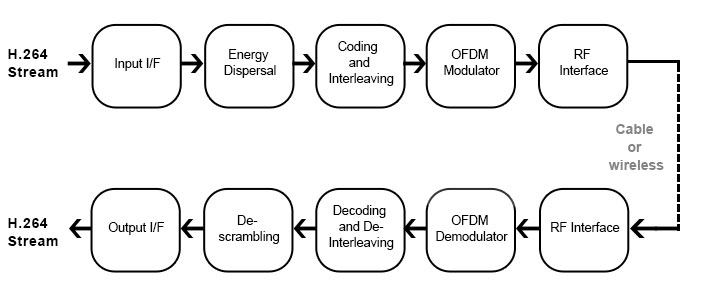
Features of ccHDtv

- Reuse existing coaxial cable deployment without any upgrade
- Same planning, deployment and debugging processes as traditional CCTV
- Any iDTV set with DVB-T feature can receive ccHDtv signal without an HD DVR
- Return channels supported:
- Full duplex communication
- PTZ control, camera configuration, I/O settings, return audio, remote firmware update
- Eavesdropping Prevention — supports encrypted signals
- No frame drops and real-time delivery
- Quasi-zero latency; quasi-real-time preview for 9x, 16x, 32x…
- Long distance transmission:
- 3c2v/RG-59 up to 500M+ without repeater
- 5c2v/RG-6 up to 1,000M+ without repeater
- Digital repeater for infinite extension
- High bandwidth: Multiple full HD camera streams over a single coaxial cable
ccHDtv Full HD Surveillance System
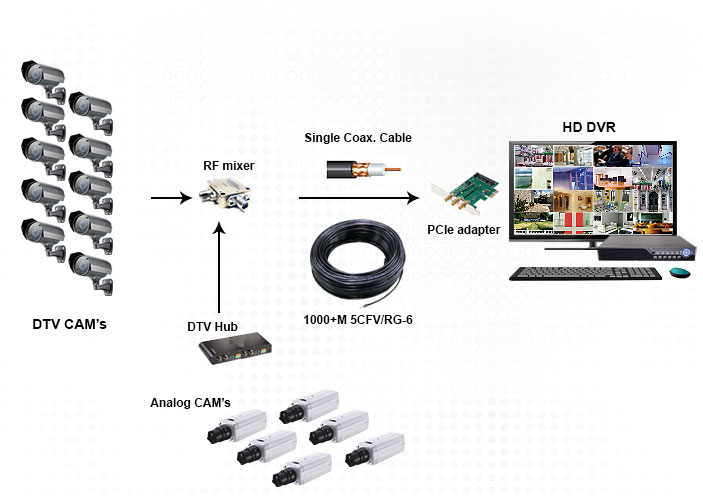
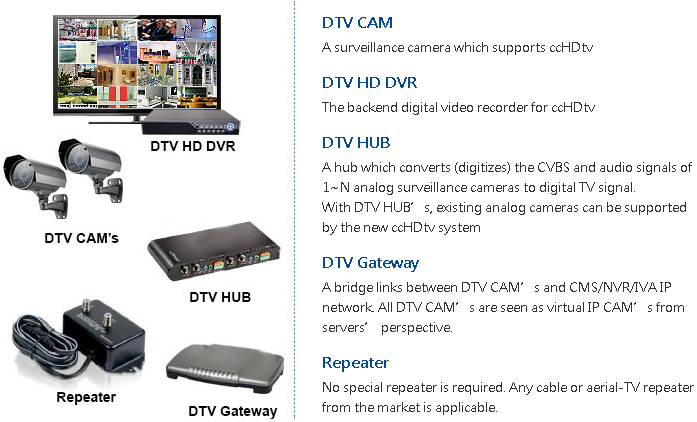
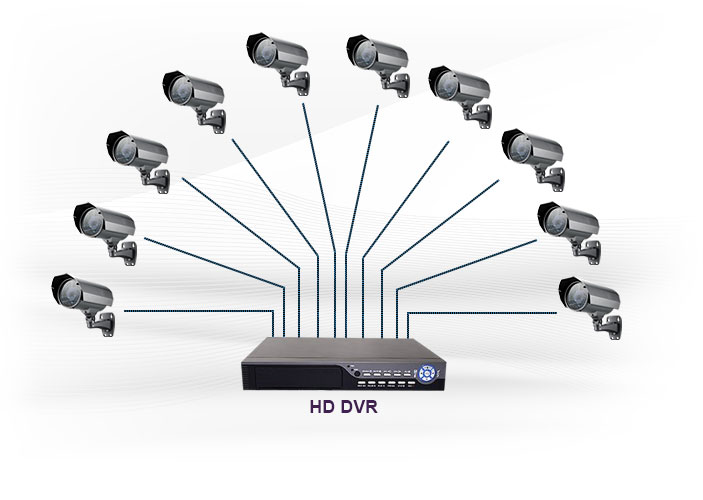
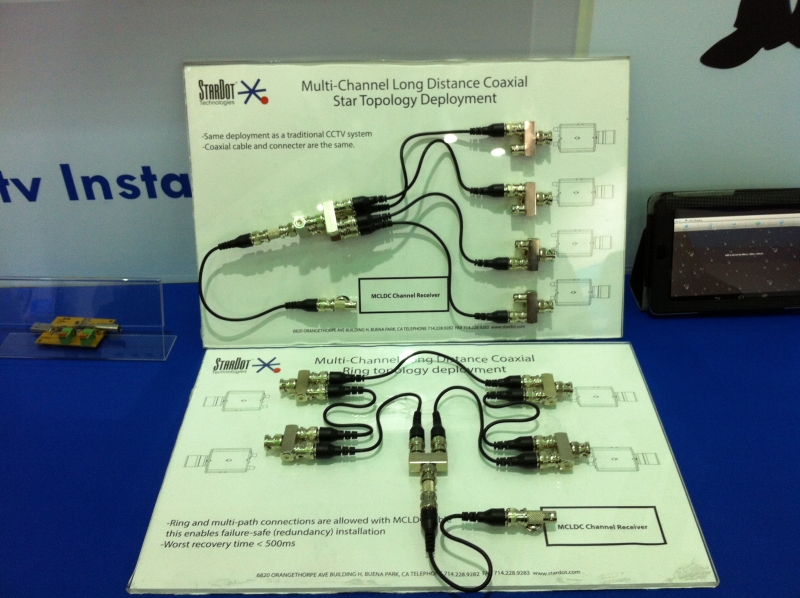
Star Topology: Same as traditional CCTV deployment — same cable and connectors. Cable medium requirements for DTV CAM are actually less than for analog cameras.
Bus Topology: Similar to cable TV deployment. Allows multiple DTV CAMs on a single cable using coaxial cables, connectors, mixers and amplifiers.
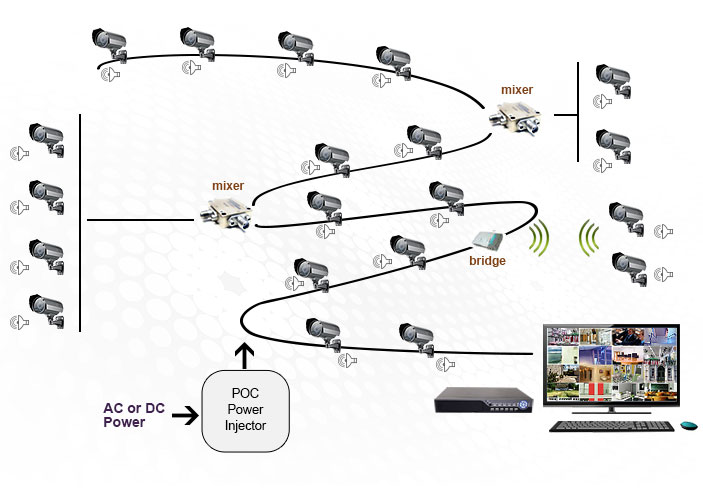
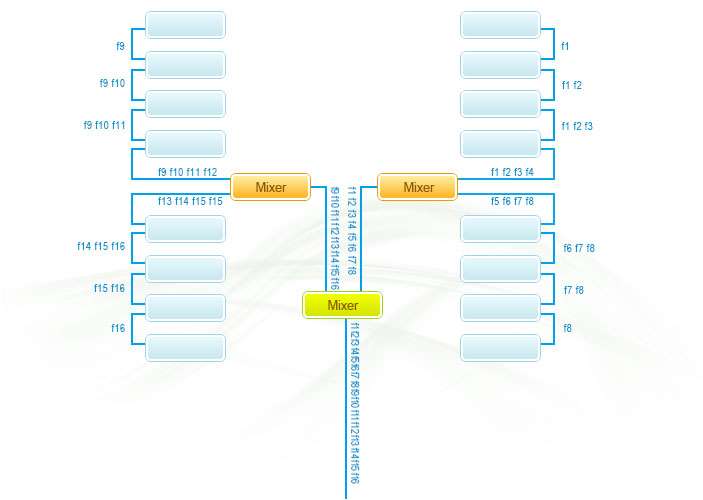
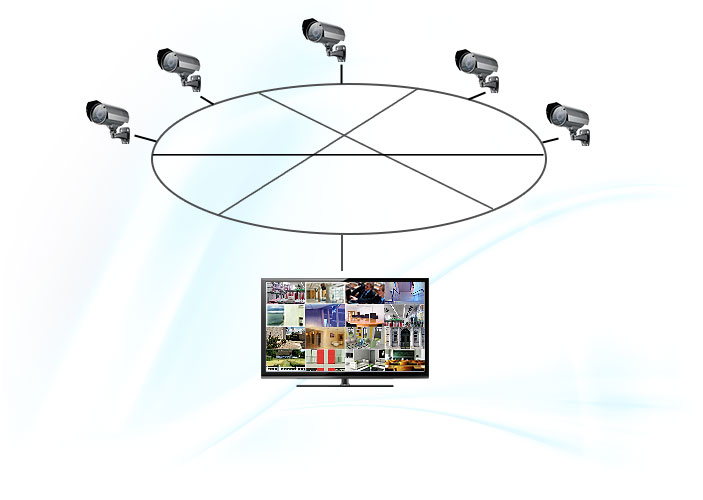
Ring Topology — Failure-Safe (Redundant) Cable Deployment: Ring and multi-path connections are allowed, enabling failure-safe redundancy. Worst recovery time: <500ms.
Source: http://www.cchdtv.com.tw/en/intro.php | FAQ: http://www.cchdtv.com.tw/en/faq/index.php
Specification Highlights
- Full duplex communication (two-way audio and control)
- Multiple streams supported; max data rate per channel: 32Mbps
- Wireless transmission is technically possible (regulations vary)
- Power over cable supported (both AC/DC)
- Crypto supported
Pros vs. HDcctv
- Media is compressed — ccHDtv can achieve much longer distances
- Supports bus and star topology — easier installation and lower cable cost
- Supports multiple stream transmission (HDcctv cannot)
- Supports crypto (HDcctv struggles with this)
- Uses TV standard — stronger backend support
Cons vs. HDcctv
- None — unless you count that the media is compressed
Pros vs. IP Camera
- Ethernet bandwidth is limited and degrades with multiple IP cameras. ccHDtv gives each camera its own proprietary data channel (up to 32Mbps) with guaranteed no frame drop
- Video quality is quasi-equivalent to lossless compression
- Latency is more stable than IP (IP can only define best-case latency)
Cons vs. IP Camera
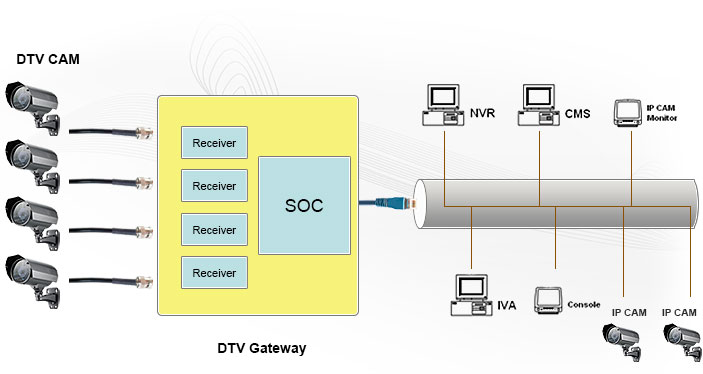
- Theoretically supports 120+ DTV CAMs, but 32–48 cameras recommended to minimize adjacent channel interference. Better suited for small/medium projects (though it can co-work with IP via gateway)
Conclusion
- Large-scale replacement of existing infrastructure to pure IP is unlikely. Only brand-new large projects will go all-IP
- ccHDtv creates a much simpler path for upgrading traditional VGA systems to HD
- ccHDtv can co-exist with IP systems
- IP NVR systems can be leveraged to support DTV cameras — a DTV camera is essentially an IP camera with a different interface
- ccHDtv uses proven TV standards — it’s robust
My view: ccHDtv poses a real threat to IP cameras and could significantly slow down the transition to IP-based surveillance.
Comments & Feedback