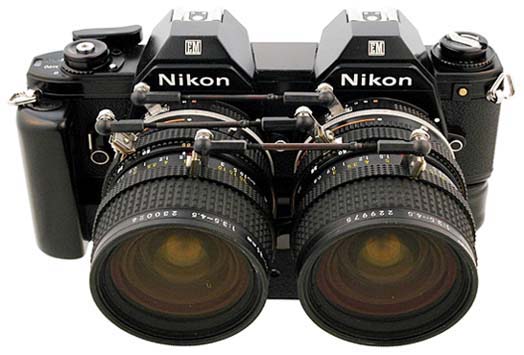
3D image and video has been booming in recent years due to the entertainment industry — movies and gaming. Many kinds of 3D devices have appeared, including 3D cameras and 3D TVs. The early approach to capturing 3D images was simply to strap two cameras together and post-process the two photos into one.
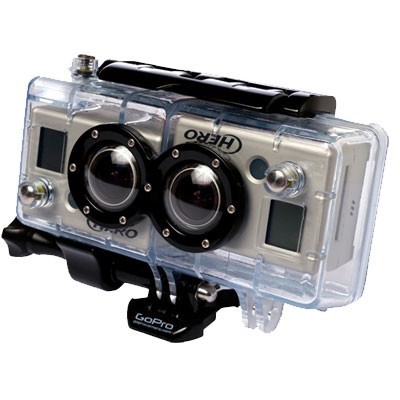
GoPro had a similar structure for their Hero camera — you’d buy two cameras with some accessories to create it.
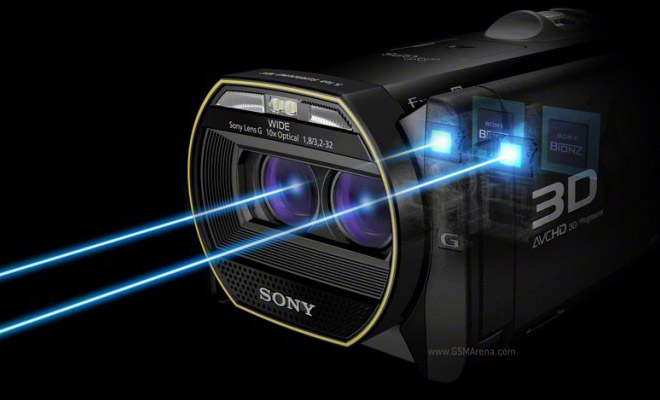
Some devices have embedded two lenses and sensors natively for 3D capture, like Sony’s camcorders.
I saw a news article on Tech-on today: Panasonic developed a 2.1-Mpixel CMOS image sensor capable of capturing 3D video with a single lens, announced at ISSCC 2013.
http://big5.nikkeibp.com.cn/news/semi/64837-20130222.html
For capturing 3D video, it is necessary to separate light entering the left eye from light entering the right eye, and direct each to different pixels of the CMOS sensor. Panasonic employs a structure combining a lenticular lens and mirror elements (digital micro lenses: DMLs), formed by patterns whose size is smaller than light wavelength using lithography technology.
The lights separated by the lenticular lens are focused by the DMLs to increase intensity. They then enter the corresponding pixels of the CMOS sensor. Because the left-eye and right-eye lights don’t interfere with each other much, signal intensity is high enough. The received signals are then processed via line memory to create 3D video.
Panasonic is planning to apply this CMOS sensor to industrial and mobile devices, with products expected to debut in 2014.
This could enable much lower-cost 3D camera systems using just a single lens — though there are still open questions about sensitivity, resolution, optical format requirements, backend processor support, and of course the sensor price. I’m very excited about this sensor because it could dramatically simplify 3D device design — with many interesting applications especially in imaging systems.
Comments & Feedback